a database of literary landscapes
CITIES IN FICTION
HOME
Mumbai
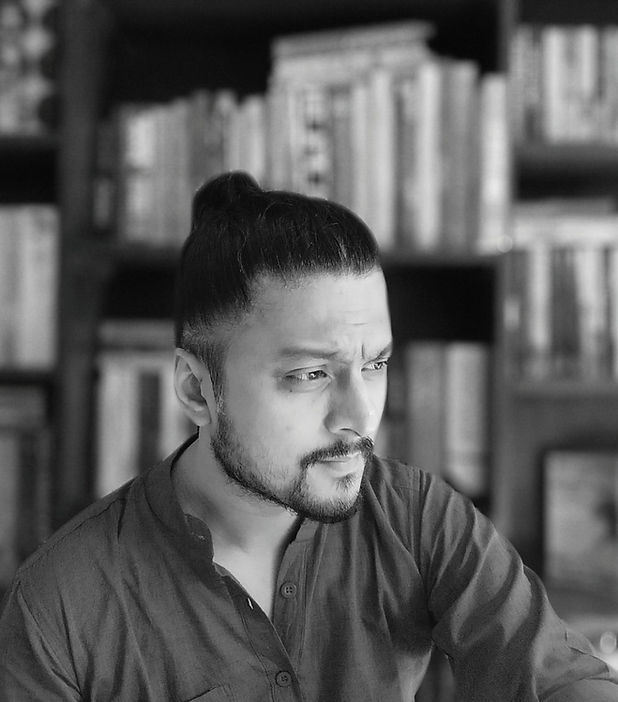
An interview with writer, editor, and novelist,
Sayantan Ghosh
By Divya Ravindranath
17 March 2026
Sayantan Ghosh was born in Calcutta, India. He is the editorial director of Simon & Schuster India. His writings have appeared in Ambit Magazine, Electric Literature, Litro Magazine, The Quint, Firstpost, The Telegraph, National Herald, The Hindu Business Line, The Times of India and numerous other publications. He was awarded the Editor of the Year award at the Publishing Next Industry Awards 2023. He lives and writes in New Delhi, India. Lonely People Meet is his first novel.
In this interview, he talks to us about the Delhi of his novel; the specific aloneness of small towns -- now a luxury; the question of genre bending; the influence of writers like Philip K. Dick, James Baldwin, Joan Didion, Kazuo Ishiguro, Teju Cole, Annie Ernaux, and Arvind Krishna Mehrotra on his writing; the struggle to separate the editor from the writer to simply get the work done; and of course, his favourite city books.
1. Delhi is one of India's most written-about cities, yet it can feel very different depending on who is narrating it. How did you want your Delhi to feel — and what did you want to capture about it that you felt hadn't quite been captured before?
There’s a sense of isolation one only feels on the streets of big cities like Delhi NCR — when you’re standing beneath the dazzling Gurgaon lights with countless cars speeding by, or making your way through the bustling market in Kalkaji where everybody is jostling each other and bumping into autorickshaws only to return to a room that goes awfully quiet only minutes later. Especially when new in the city, trying to build a career amidst uncertainties like I was when I first came here a little over thirteen years ago. I’m not sure it was novelty I was seeking through my depiction of Delhi, instead I was searching for a reality that makes you uneasy and yet feels eerily familiar.
2. Cities in fiction often function as more than backdrop — they become a kind of emotional mirror for the protagonist. At what point in the writing did you realize Delhi itself was doing significant narrative work in the novel?
Quite early on. In fact, the prologue of the novel is set on the Nelson Mandela Marg which runs alongside the monstrous Vasant Kunj malls and is primarily a scene about everyday police brutality. It’s the kind of Delhi I’m fairly used to now; one that peeks behind the curtain of its magnificent monuments and abundant public parks. Both these Delhis appear in the novel, and both play equally significant parts in the story I was trying to tell.
3. The city seems to both enable and deepen Karno's loneliness. Do you think Delhi, as a megacity, has a particular relationship with isolation — something distinct from what a smaller Indian city might produce in a character like him?
Most certainly. Smaller cities offer you aloneness, a city like Delhi doesn’t easily allow you such luxuries. But aloneness is different from loneliness. Several years ago, I used to live in a small town called Balasore in Odisha which used to have a very small population, and the town nearly shut down after eight every evening. On some days, I’d feel an acute sense of aloneness, but rarely ever did I feel disconnected from the world — even though these were pre-Jio days when cheap internet wasn’t readily available in every nook and cranny of India. The kind of isolation Delhi offers could easily be all-consuming — and it’s closely connected with the general temperament of the city and the stark class hierarchies it swears by.
4. Devaki's consistent redirection of conversation toward her past relationship with Faiza creates a kind of emotional asymmetry between the two leads. Was that imbalance — one person wanting connection, another caught in memory — something you consciously designed as a representation of how urban relationships often unfold?
Yes, that was consciously done. I wanted them to be on very different pages while simultaneously seeking a real connection. That’s what often happens in real life too — two perfectly all right people are unable to co-exist in harmony simply because they might be joined at the hip or living under the same roof and yet looking in completely separate directions. In this case, Karno is trying to find a reason to look forward to his future, while Devaki, when we first meet her, is stuck in her past. There’s, of course, a reason behind why she is the way she is… which you and I both know I can’t give away in this conversation.
5. This is your debut novel. Looking back, was there a version of this story that was significantly different — a draft where the shape, the ending, or even Devaki's identity was something else entirely?
Not at all. This is more or less how I wanted the novel to read when I started writing it. I deliberately didn’t rush through the process, and it perhaps took me more time to write it than a more competent novelist would have taken. But I always knew where the story is headed even if the minor details kept altering slightly as I proceeded. In some ways, I started with the end and then tried to find the most uncomfortable way to reach it with the assistance of my indecisive, oddball protagonist.
6. The novel moves across romance, speculative fiction, literary fiction, and philosophical fable. Did you set out to write something deliberately unclassifiable, or did the genre-blending emerge naturally as the story developed?
I was at a bookstore recently where the manager wryly complained that they aren’t sure which shelf to place the book on — romance, mystery, or sci-fi. And my brain instantly told me that it’s a good problem to have. There was honestly no deliberate attempt on my part to write something that subverts tropes or blends genres, only a genuine effort to not limit my imagination simply because it perhaps isn’t complying with genre norms sometimes.
7. You work as an editor, which means you spend your days sharpening other people's prose and making difficult calls about structure, pacing, and what stays on the page. When you sat down to write your own debut, did that editorial eye help you — or did it get in the way, making you your own harshest critic before a sentence was even finished?
For the first few months, it kept getting in the way. I’d write a few pages and then when I revisited them, I had to go look for a barf bag. Eventually I realized that it isn’t for me to decide whether what I was writing turns out to be a readable novel or not — I had to separate the editor from the writer to simply get the work done. A line I read once describes the act of writing perfectly: make it exist first, you can make it good later.
8. The title Lonely People Meet almost immediately calls to mind Olivia Laing's The Lonely City — both circle around urban isolation as a central condition of modern life. Was Laing's work a conscious touchstone when you were titling or writing the novel?
It’s without a doubt one of my favourite works of nonfiction, possibly of all time. Subliminally, I’m certain it has influenced this novel. But so have several other works which have come before mine, without them perhaps this novel wouldn’t exist at all. The works of writers like Philip K. Dick, James Baldwin, Joan Didion, Kazuo Ishiguro, Teju Cole, Annie Ernaux, Arvind Krishna Mehrotra, and many more. The title Lonely People Meet was a play on the boy-meets-girl trope; some people who heard it before the book was published found it slightly abrupt — which only reaffirmed my belief that it’s most suitable for this novel.
9. Cities in Fiction is built on the idea that literature is one of the richest ways to understand a place. So we have to ask — what are some of your favourite books about cities? And are there any novels or works that capture Delhi specifically in a way that has stayed with you, as a reader or as a writer?
I’ve learnt more about cities from books than sometimes even by visiting them. When I’m travelling to a new city, whether in India or outside, I always try to pick up a novel based there to get a better sense of it when I’m there. Not just to memorize the map of a place, but to gain an understanding of the unique concoction which makes every city so singularly distinctive. A few of my favourite city books and cities in books are: Teju Cole’s New York City in Open City, Orhan Pamuk’s Istanbul in Istanbul: Memories and the City, Rohinton Mistry’s Bombay in Tales from Firozsha Baag, Anjum Hassan’s Shillong in Lunatic in My Head, Haruki Murakami’s Tokyo in After Dark, of course James Joyce’s Dublin in Dubliners, I could go on. And there are numerous Delhi books which must be and are already read widely, but one contemporary novel set in Delhi which has stayed with me is Deepti Kapoor’s sinuous and gritty A Bad Character.