
a database of literary landscapes
CITIES IN FICTION
HOME
Mumbai
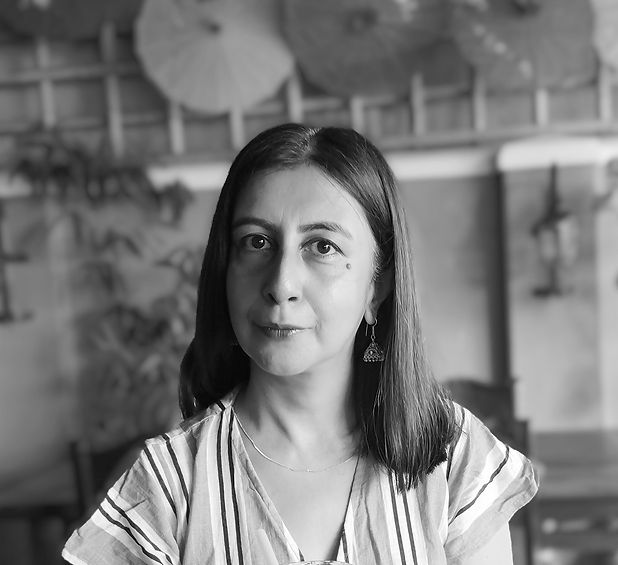
An interview
with novelist, short story writer,
poet, and editor,
Anjum Hasan
By Apoorva Saini
1 May 2026
Anjum Hasan is the author of the novels History’s Angel, The Cosmopolitans, Neti, Neti and Lunatic in my Head, and the short story collections A Day in the Life and Difficult Pleasures. Her first book was the poetry collection, Street on the Hill. A non-fiction book on Shillong, Hometown, will appear in 2026.
In this interview, she shares with us her interest in what makes our cities different from each other; the idea of everyday enchantments and the unplumbed beauty in the ordinary; what excites her about contemporary Indian writing as an editor; the disappearance of spaces for reflection; her upcoming book; how she met her husband, Zac, also a novelist; and a poem on siblings, among other things.
1. I am writing to you from Karwar, Karnataka. Where are you writing to us from?
I’m writing from a summer in Bangalore.
2. Places—be it Shillong of Lunatic in my Head; Bangalore in Neti Neti; the unnamed village of central India in The Cosmopolitans; or Delhi of History’s Angel—nurture the core ideas in your fiction. In each case, that particular story could exist, rather be born, only in that particular place. Could you please take us through how cities are embodied in each of these books?
There was very little fiction about these places in the present and I wanted to imagine them in writing. And to do that through characters who are grappling with the nature and the history of Shillong or Delhi or Bangalore so that it becomes part of their sensibility.
I’m also very interested in what makes our cities different from each other, the acutely local: street life, lingo, body language, certain tastes and smells. That gets obliterated by an enforced globalised sameness and the other thing often wiped out is even the recent past –people and places and ways of feeling. Novels can become archival in that sense. Neti, Neti, for instance, from 2009, is about a Bangalore that feels to Sophie Das alarming and estranging in its newness. Today I’m not sure how to describe newness because it’s the norm in every department of life, no longer the surprise.
3. Earlier this year at Bangalore International Centre, you interviewed Amitav Ghosh for his latest novel Ghost Eye. At a point in the discussion, you made a wonderful inquiry about everyday enchantments within the larger enchantments in the territory of fiction. In your work, exploration of the everyday and the ordinary is recurring and very much central than at the periphery. Could you please reflect for us what interests you in these particular themes?
I’d like to believe that there is still unplumbed beauty in the ordinary and that it’s where a large part of life takes place. The persistence of the day-to-day is what keeps people going despite the general sense of a planetary crisis that we all live with. Conversely, the fantasy and the supernatural that so many writers now are drawn to does not by definition make for an enchanted literature. It can in the hands of exceptional writers – I remember mentioning his magically spooky Calcutta Chromosome to Amitav Ghosh in that conversation with him.
But it gets harder to write about everyday enchantments – one reason being that our cities are ever more segregated along class lines and what constitutes everyday charm to you and me could just be brute reality to the working class. Then again, we need to find new ways of talking about class and about people in general, an idiom that is not only economic or not only cultural – we are not just different categories of labour and income-earners and not just a set of tribes locked into our religion and food and language.
4. The other signature element in your work is the presence of an anachronistic protagonist. Alif in History’s Angel is a perfect example, however my personal favourite is the man in your short story The Stranger. Would you say a person who feels out of place is a vigilant observer of his surroundings, and that quality in them allows the author a keener eye for details ?
It could be that I am myself forever anachronistic and failing to catch up. Though we’re all trapped in the same hell – conspired obsolescence, upgradation at knife-point, use and throw or perish. On the other side is regression, the growing tribalism I spoke of. The one who feels out of place is certainly able to see all of this clearly and by that same token could also be more easily crushed by it. As Jonathan Franzen once wrote about the person at odds with the world, she wants to say, I’m not depressed, I’m right. How to find a language for that sense of rightness which is not just defensiveness or preaching to the converted, this is the challenge before the novel.
5. The Cosmopolitans, is a novel about the passage of time. For the same reason, it also reads like a bildungsroman. From the world of urban art galleries to the question of practicing artists survival in rural areas, Qayeenat’s journey is one of a kind in contemporary Indian English novels. Please share how this journey took shape.
Before I wrote that novel, I had worked in an arts foundation for 11 years and was meeting artists often, travelling all over the country and seeing the range you describe: hard-nosed professionals in the cities and hard-up artists in villages trying tatteredly to keep the flame burning. I am pleased you think of it as a bildungsroman because I wanted to write, humorously if possible, about those artists but in relation to Qayenaat’s uncommitted and unambitious outlook and how it fares in the “new” India. What does her sort of seriousness look like and how quickly does it become a farce?
6. In your visual essay For and Against the Nation, published in 2022 in The Bombay Literary Magazine , you captured ‘a dense and shifting urban jungle of symbols and signs’ in Shillong. What would that essay look like in 2026? Also, your upcoming book of non-fiction, Hometown: A Personal History of Shillong, was recently posted about by New India Foundation. Does the book share its themes with the TBLM essay?
I’m glad you spotted that piece, it was an early stab at something I’d like to get better at – the photo essay. Hometown, which will be out later this year, is a bit more ambitious in the sense that this time I’m trying to swallow Shillong whole! Waiting to see how that goes down. It’s a chorus of voices, speaking against the background of the present pressures on the city and its hundred-and fifty-year-old past. Shillong had a cosmopolitan elite and a very educated and self-aware middle class so I’m trying to recover that history rather than further the distorted idea that the town was one outpost of the “forgotten Northeast”.
7. I remember reading The Caravan from a time when you used to be one of the fiction editors. You also co-edited a fantastic anthology called Future Library. Could you please share what’s most exciting about contemporary Indian writing to you as an editor?
I keep seeing lately the news that Indians don’t read anymore. The space for reflecting on writing has virtually disappeared since the time I was in The Caravan. So all reading of new work feels surreptitious and private, yet one does still make worthwhile discoveries. Two young writers have recently struck me as deeply familiar with and interested in their societies, Linthoi Chanu and Gankhu Sumnyan.
8. What is the first book that comes to your mind when you read the following words?
Siblings : Little Women
Uncanny : Austerlitz
Railways : Anna Karenina
Parrot : Flaubert’s Parrot
Chocolate : I Too Had a Love Story
9. If you don’t mind, may I ask how you and your husband Zac met? It is rather rare (and heartwarming) to come across two novelists who have built a life together in India. What is your literary relationship with each other like? Do you share writing routines and rituals? Most importantly, how do you get enough shelf space in the house?
We met at a New Year’s Eve house party in Bangalore and got married in my parents’ place in Shillong two years later, at the end of the year 2000. It still feels like an ongoing conversation, we’re talking all the time about books, writing, reading, the literary world. And we’re the first readers of each other’s work (the part of his work that Zac writes in English, rather than Swedish, whereas I only write in English). We can agree on what makes for literary merit yet have different personalities and tastes and we don’t collaborate, our writing projects (and our work spaces) are very separate. Shelf space is an eternal problem. We have a place in Coorg where we go to write and one in Bangalore and we’re just renting a second apartment here to make more room for books.
10. For the concluding question, I want to go back to your first book. Which is your favourite poem from your poetry collection Street on the Hill? Can you please share it (or an abstract) here with us?
The word “sibling” above took me back to a poem called “To the Chinese Restaurant”, a very urban poem too. Here it is:
To The Chinese Restaurant
(for Daisy)
We come in here from the long afternoon
stretched over the town’s sloping roofs,
its greasy garages and ice-cream parlours,
its melancholic second-hand bookshops
with their many missing pages.
Life’s not moving.
We sit at a red table, among the dragons,
near the curtained-off street-facing windows
with their months’ old orangeade.
Out in the streets there are schoolboys with
their ties askew and the garish fruit-sellers.
We eat more than we need to. We eat
so that our boredom’s no longer dangerous,
so that from the comfort of soup,
with the minor pleasures of chopsuey,
we can fend off the memory of cities unvisited,
unknown and unknowable affairs,
people with never-fading lipstick and
confident gestures who we will never be.
One day soon we’ll be running,
our lives will be like the blur seen from a bus,
and we won’t read each other’s letters thrice.
But right there we’re young, we count
our money carefully, we laugh so hard
and drop our forks.
We are plucked from sadness there
in that little plastic place with the lights
turned low, the waiters stoned from doing nothing,
the smells of ketchup and eternally frying onions.